Pharmaceutical Grade PEGs: Types, Purity Standards, and What to Verify in a GMP Supply Partner
Polyethylene glycol, commonly known as PEG, is widely used in pharmaceutical formulations, drug delivery systems, topical products, and solid dosage forms. Its value comes from the availability of different molecular weights and functional properties. However, pharmaceutical use requires more than choosing a PEG with the right viscosity or molecular weight. The material must also meet appropriate quality, purity, documentation, and supply chain requirements.
For pharmaceutical manufacturers, selecting a pharmaceutical grade PEG means evaluating the grade against relevant pharmacopeial specifications and the intended formulation.
What Is Pharmaceutical Grade PEG?
Pharmaceutical grade PEG is polyethylene glycol manufactured and controlled for use in pharmaceutical products. Polyethylene glycol is an addition polymer of ethylene oxide and water, with commercial grades generally identified by a number related to their nominal average molecular weight. The current USP-NF monograph defines acceptable average molecular weight ranges relative to the labeled nominal value, with different tolerances depending on molecular weight.
The term pharmaceutical grade should be supported by evidence. Depending on the market and application, this may include USP-NF, European Pharmacopoeia, or other applicable compendial compliance, together with controlled manufacturing, batch documentation, traceability, and a suitable pharmaceutical excipient quality system.
A PEG may be chemically similar to a material used in an industrial process, but chemical identity alone does not establish pharmaceutical suitability.
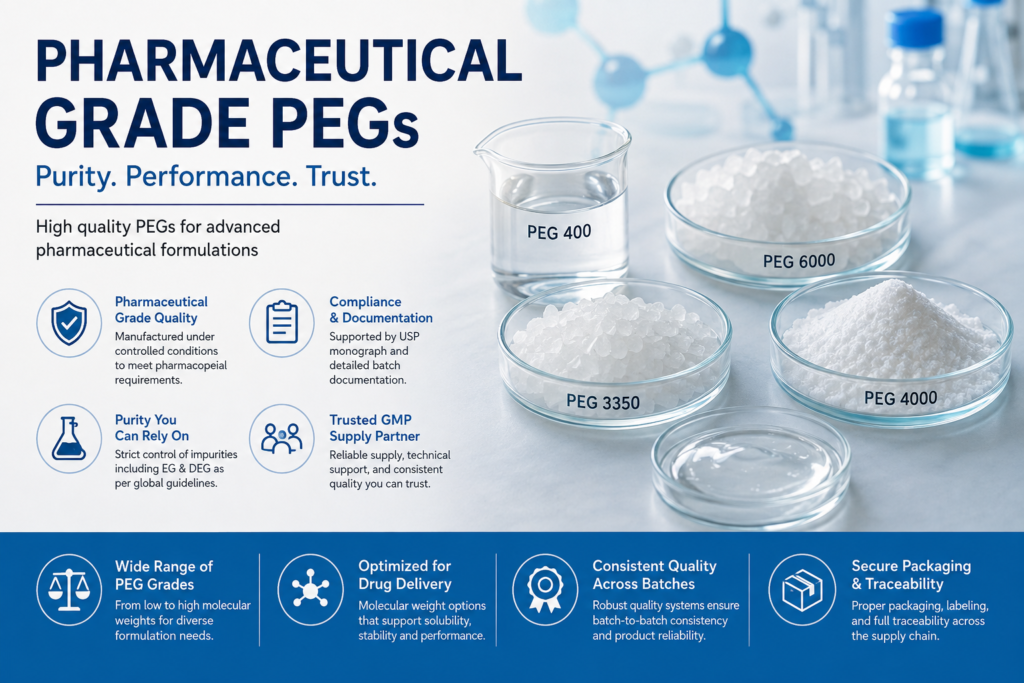
Common PEG Grades Used in Pharmaceutical Formulations
Different PEG grades provide different physical and functional properties. Lower molecular weight PEGs are generally liquid, while higher molecular weight grades become semi-solid, waxy, flaky, or solid. Physical properties such as viscosity and solidification point also change as molecular weight increases.
Commonly encountered PEG grades include:
- PEG 200, PEG 300, PEG 400, and PEG 600, generally used as lower molecular weight liquid grades.
- PEG 1000 and PEG 1500, which provide intermediate consistency where semi-solid or waxy properties are useful.
- PEG 3350, PEG 4000, PEG 6000, PEG 8000, and other higher molecular weight grades, which are generally solid and may provide body, matrix-forming ability, or controlled physical properties.
The most appropriate grade depends on dosage form, processing conditions, API compatibility, release characteristics, and final product performance. Suppliers should provide clear grade identification and specifications rather than relying on a broad description such as “PEG pharmaceutical grade.”
Why PEG Molecular Weight Matters in Drug Delivery
The relationship between PEG molecular weight and drug delivery performance is an important formulation consideration. Molecular weight influences viscosity, physical state, solubility behavior, melting or solidification characteristics, and interaction with other formulation components.
Lower molecular weight PEGs may be selected as solvents, co-solvents, humectants, or formulation aids in certain liquid and semi-solid systems. Higher molecular weight PEGs may contribute structure, consistency, matrix properties, or modified dissolution behavior.
In advanced drug delivery, PEG chains may also be attached to molecules, surfaces, lipids, proteins, or other delivery components. Chain length can influence steric protection, hydrophilicity, particle behavior, circulation characteristics, and interaction with biological environments.
For this reason, PEG molecular weight drug delivery decisions should be based on formulation objectives and validated performance rather than on molecular weight alone.
Pharmaceutical Grade PEG vs Industrial Grade
The difference between pharmaceutical grade PEG vs industrial grade PEG is mainly related to intended use, specification, manufacturing controls, testing, documentation, and supply chain assurance.
Industrial PEG may be suitable for coatings, lubricants, processing aids, chemical manufacturing, or other technical uses. It may meet an industrial specification while lacking the compendial testing, impurity controls, traceability, change notification procedures, and GMP-oriented documentation expected for pharmaceutical applications.
Pharmaceutical grade PEG should be supported by an appropriate specification and Certificate of Analysis. The supplier should also demonstrate control over manufacturing, contamination risks, packaging, storage, deviations, and significant changes.
For a regulated pharmaceutical formulation, substitution based only on a matching PEG number can create unnecessary quality and regulatory risk. A material identified as PEG 400 for an industrial process, for example, should not automatically be considered interchangeable with PEG 400 manufactured and tested for pharmaceutical use.
Understanding PEG Purity Standards
PEG purity standards are not limited to a single percentage assay. Pharmaceutical suitability may involve identity, average molecular weight, impurity limits, water or moisture-related controls, physical characteristics, and other tests specified by the applicable monograph or internal material specification.
The USP PEG monograph establishes molecular weight requirements according to the labeled nominal value. It also addresses ethylene glycol and diethylene glycol testing, which has received increased regulatory attention because of contamination and adulteration risks associated with certain pharmaceutical excipients.
FDA guidance on high-risk drug components specifically emphasizes the danger of diethylene glycol and ethylene glycol contamination and states that manufacturers should reference the current USP-NF to determine required testing. The guidance includes polyethylene glycol among materials for which current compendial requirements may include DEG and EG controls.
In Europe, EMA guidance states that incoming macrogols, or polyethylene glycols, with relative molecular mass below 1000 should be tested according to the relevant European Pharmacopoeia monograph. It also notes that the monograph for macrogols below 1000 includes a specific limit test for ethylene glycol and diethylene glycol.
These controls highlight why purity specifications should be reviewed at the individual grade and market level rather than assuming that every PEG follows an identical testing profile.
What the USP PEG Monograph Means for Pharmaceutical Buyers
The USP PEG monograph provides an important compendial reference for polyethylene glycol used in pharmaceutical applications. The current monograph defines PEG and establishes molecular weight acceptance ranges.
USP has also revised its approach to EG and DEG controls, with specific attention to lower molecular weight PEGs because liquid and semi-solid grades can present greater contamination or adulteration concerns.
A supplier claiming USP compliance should identify the applicable monograph version, provide a specification aligned with current requirements, and issue batch-specific analytical documentation. Testing responsibility and supply chain traceability should also be clear.
Compliance with a USP PEG monograph should therefore be verified through documentation rather than assumed from a product name or marketing description.
Frequently Asked Questions
1. What is pharmaceutical grade PEG?
Pharmaceutical grade PEG is polyethylene glycol manufactured and tested for use in pharmaceutical formulations. It is typically supplied with defined specifications, batch documentation, impurity controls, and compliance with applicable pharmacopeial standards such as the USP PEG monograph or other relevant compendia.
2. What are the common PEG grades used in pharmaceutical applications?
Common PEG grades include PEG 200, PEG 300, PEG 400, PEG 600, PEG 1000, PEG 1500, PEG 3350, PEG 4000, PEG 6000, and PEG 8000. The appropriate grade depends on molecular weight, physical form, viscosity, formulation requirements, and intended pharmaceutical use.
3. What is the difference between pharmaceutical grade PEG vs industrial grade PEG?
The main difference between pharmaceutical grade PEG vs industrial grade PEG lies in quality controls, intended use, testing, documentation, traceability, and regulatory compliance. Pharmaceutical grade PEG is produced and tested to meet pharmaceutical requirements, while industrial grade PEG may be intended for technical or manufacturing applications.
4. What purity standards should pharmaceutical grade PEG meet?
PEG purity standards depend on the specific grade, intended application, and applicable pharmacopeia. Manufacturers may need to review identity, molecular weight, water content, impurities, ethylene glycol, diethylene glycol, and other parameters defined by the relevant monograph or approved material specification.
5. What is the USP PEG monograph?
The USP PEG monograph is a pharmacopeial standard that defines requirements for polyethylene glycol used in pharmaceutical applications. It includes specifications related to identification, average molecular weight, and applicable impurity controls. Pharmaceutical manufacturers should always verify compliance with the current monograph version.
Choosing the Right Partner for a Molecule
Choosing a pharmaceutical grade PEG requires more than matching a nominal molecular weight to a formulation. The selected PEG must provide the required functional performance while meeting appropriate purity, compendial, documentation, and supply chain expectations.

Keshav Bhutada
CEO, API Division | Shilpa Pharma Lifesciences
Leads Shilpa Pharma’s API business with a focus on differentiated products, CDMO growth, regulatory readiness, and global competitiveness across oncology and non-oncology portfolios.